



How does the bedwetting alarm work?
Treatment for bedwetting is generally divided into two stages: a support phase and definitive treatment. These are both distinct but interconnected and should not be undertaken without the help of an adult or experts.
- The support phase: "To make life easier" until the children stop wetting themselves. This includes absorbent underwear, diapers, and bed pads. Nighttime trips to the toilet, known as the "lifting method," can help reduce fluids. Motivational techniques and medication are also used.
- The treatment phase: Currently, bedwetting alarms are the only solution for a definitive cure. According to a recent study, children who used a bedwetting alarm not only became dry but also experienced an increase in their functional bladder capacity. Although the exact mechanism of this phenomenon is unknown, it involves the ability to store more urine.
Let's group this information into a table.
SUPPORT PHASE |
Percentage of children who were "dry" the following year |
| - To wait for | 15% |
| - Fluid Restriction | 15% |
| - Waking the child up during the night | 15% |
| - Use of a classic alarm clock | 15% |
| - With medication (for 3 to 6 months) | 15% |
TREATMENT PHASE |
|
| - Bedwetting alarms | 87% |
A bedwetting alarm is a treatment tool designed to teach your child to respond to the signal of a full bladder by waking up on their own .
Alarms come in several different styles:
- portable alarms
- wireless alarms,
- and mattress probe type alarms.
Although there are some variations in the styles of the alarms, they all work in a similar way. Each alarm has a moisture sensor and an alarm element. When the child begins to urinate, the sensor detects the moisture and the alarm sounds.
Portable alarms:
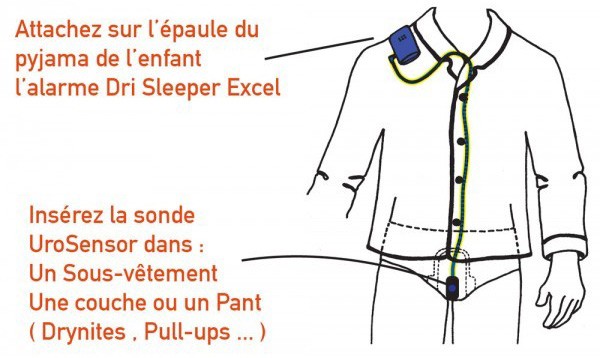
With wearable bedwetting alarms, the child wears the moisture sensor inside or on their nighttime underwear. This type of sensor detects moisture almost immediately. The sensor is attached to the alarm unit with a cord that can be threaded under the shirt. These are the best alarms for most children. Our most effective alarms are from the Rodger and Anzacare brands.
- Rodger Clippo and Clippo+ alarms
- Anzacare Dri Sleeper Excel Alarm
Method for attaching portable alarms:
Wireless alarms:
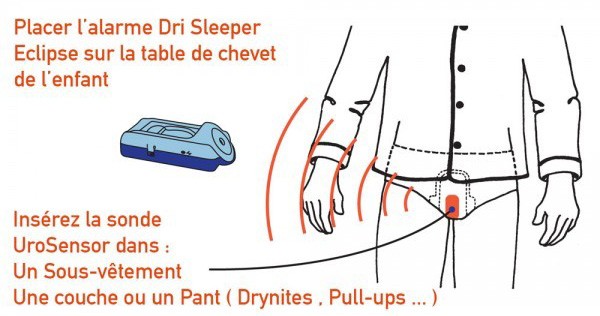
A wireless alarm is one in which the sensor and alarm unit communicate via a means other than a wire. The transmitter that detects wetness is attached directly to the child's underwear. The signal is transmitted wirelessly to a unit located in the child's room. Once the alarm unit is activated, the child must get out of bed to turn it off. This type of alarm is useful for children who prefer not to wear a shirt to bed or those who find wearing an alarm with a cord neither easy nor comfortable. The Rodger Wireless Alarm is our most advanced wireless model. And the Dri Sleeper Alarm allows you to wear protective clothing even during treatment.
- Rodger Wireless Alarm
- Dri Sleeper Eclipse Alarm
- Uriflex Alarm
How to use wireless alarms
Alarms with Mattress Sensor.
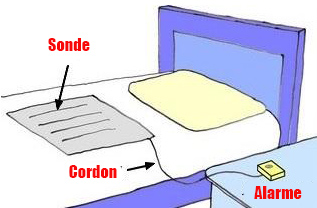
The sole advantage of these mattress-type sensor alarms is that they don't require the child to be attached. The moisture sensor is in the form of a pad or mat on which the child sleeps. The sensor detects moisture as soon as urine touches the sensor. The sensor is connected to the alarm unit by a cord. It is usually placed on a bedside table. This alarm can be suitable if the child cannot tolerate having anything attached to their clothing. When purchasing this type of alarm, it is recommended to choose a model that has adjustable sensitivity settings for the mattress sensor, such as the Dr. Sagie model.
Installation diagram for mattress-type probe alarms
Posted in:
Bedwetting Alarms





Latest comments