



Bedwetting alarm: what you need to know before buying
Many bedwetting alarms are available today, all with similar functions, but some are more effective than others. We advise you to be wary of certain unreliable and often very poor-quality devices.
Here are the important points to check before any purchase or rental.
Establish a diagnosis:
Before buying or renting any bedwetting device, we recommend that you clearly differentiate between primary and secondary enuresis.
- Primary: In 85-90% of cases, the child has never been dry at night
- Secondary: The child has been dry at night for more than 6 months. We advise you to treat your child with a nightlight but also to consult a doctor to determine the cause of this relapse.
The user: Careful, it's a child!
We often forget that the primary user is a child. Therefore, their age and motivation must be taken into account. Treating a child is relatively easy but requires a certain degree of independence and genuine motivation to adhere to the treatment regularly. The average duration is two months. We recommend a minimum period of 1.5 months and 21 consecutive dry nights. Some manufacturers recommend 14 consecutive dry nights. Our experience in this area leads us to advise 21 nights to minimize the relapse rate.
Wired or wireless:
Although wireless and wired devices often have the same features, we recommend this rule:
- With wire: for daytime urination treatment or monitoring
- Wireless: for nighttime bedwetting treatment
Many parents choose wireless models to avoid having a wire between the alarm and the sensor that could disturb the child during sleep. They are also easier to use in the evening and during the night in case of urination.
1, 2, 3, 4... ringtones, is that better?
This is probably the question we hear most often from parents during phone consultations. Some manufacturers focus their marketing on the variety of ringtones. It's purely a marketing ploy!
Our answer is very simple:
The important thing is to wake the child. It's not the number of rings that matters, but their ability to wake them. There's no point in having 20 different rings if none of them wake your child. We prefer alarms that sound at the frequency of human hearing. Among these, we recommend the Dri Sleeper range (Eclipse and Excel) and the alarm... wireless developed by Urifoon.
Make sure to choose alarms with adjustable volume to adapt to the child's environment.
With a wireless transmitter?
Generally, they are attached to the probe by means of metallic pressure plates acting as contacts. Some alarms allow for battery replacement in the transmitter ( Wireless) and others have very long-lasting batteries (Dri Sleeper Eclipse = more than 1 year)
What are the different types of probes?
There are 4 main categories of probes :
- Clip-on or clip-on type: small in size, this one clips onto the child's underwear.
- Positive point: The price
- Negative points: Its ability to detect urine only on the part in contact between the underwear and the clip, presence of a wire between the probe and the alarm.
- Mattress probe: generally measuring 60 x 60 cm, it is placed between the sheet and the child.
- Positive point: the child is not connected to the probe
- Negative points: frequent false detections due to the child's perspiration. They are fragile.
- Insertable probe: These are small probes generally made of soft PVC and are to be inserted between two pairs of underwear, a diaper or a feminine hygiene product.
- Positive point: economical and can be used in underwear or as a protective covering. Very easy to care for.
- Negative Points: Requires precise positioning for rapid detection
- Probe in underwear: These are the latest generation of probes. Threads are sewn inside the underwear and are completely invisible. This underwear looks like regular underwear and is comfortable to wear.
- Positive point: Very easy to install and large detection area. Very fast detection.
- Negative points: More expensive to buy because you need to have at least 2 or 3
With or without a diaper during treatment?
This is generally a very important point. We want to reassure you that wearing or continuing to wear protection during treatment will in no way slow it down or delay the acquisition of cleanliness.
- Some parents or children may prefer to continue wearing incontinence pads during treatment for their comfort. In this case, alarms from the Dri Sleeper range (Eclipse or Excel) should be considered.
- If the child doesn't wear protective pads, they can choose from the entire range offered on our website. If your child wants the Dri Sleeper, simply put on two pairs of underwear and slide the probe between them.
Is the Vibrator function important?
In most cases, a vibration function isn't necessary unless your child sleeps with other children. In that case, we recommend choosing alarms with an external vibration module (not included) because the vibrations are significantly stronger. These should be placed under the child's pillow or mattress.
Should I get up at the same time as my child?
Depending on his age, we recommend accompanying him at first to ensure he wakes up properly and empties his bladder. Don't forget to make sure he resets the alarm before going to bed. After a few days, we advise allowing him to be supervised while he sleeps independently.
My child is undergoing treatment with Desmopressin.
First, it's important to know that the relapse rate with Desmopressin (Minirin) after treatment is nine times higher than with an alarm (see: ANAES 2003: Evaluation of alarm systems in the treatment of primary monosymptomatic nocturnal enuresis). We advise you to discuss this with your doctor but not to combine medication and alarm treatment. Some studies suggest combining medication and alarms. We prefer to avoid these two treatments at the same time because they have opposing effects, and more generally, we are not convinced of their benefits.
Is it covered by Social Security?
Unfortunately not! Many European countries cover the cost of renting or buying a bedwetting alarm. In France, we still opt for medication, which unfortunately has no good results and is very expensive for the social security system (between €60 and €90 per month, depending on the child's weight). This is yet another French paradox. Simply stopping reimbursement for medication would cause sales to plummet, thus highlighting the true effectiveness of these drugs.
Rent or Buy?
Yes, if you only have one child to treat and if you rent a latest-generation device . We advise against renting from a pharmacy, which generally offers outdated Pipi Stop devices, often recommended by practitioners untrained in Pipi Stop techniques.
No, not if you have several children. In that case, it's worth considering buying one. Keep in mind that you can only treat the second child after the first.
Conclusion
Renting or buying a bedwetting alarm is currently the best solution for treating bedwetting. We recommend purchasing or renting through a bedwetting specialist and always checking whether a stand is included. We advise against buying a used alarm because these devices come into contact with your child's private parts, and it's impossible to know if the sensors are working properly.
Posted in:
Bedwetting Alarms
Related products
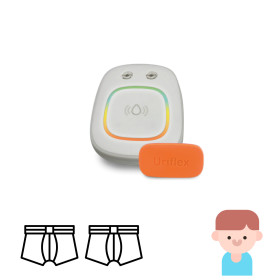
Uriflex for Boys – Set of 2 Liberty wireless nappy-training boxer shorts
Old price: €180.90
Price: €171.85
Discount: 5%
Save up: -€9.04
Set: 1 Liberty wireless bedwetting alarm + 2 pairs of boys’ boxer...
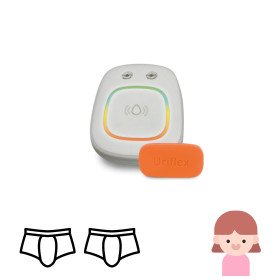
Uriflex for Girls – Set of 2 Liberty-print wireless training pants
Old price: €180.90
Price: €171.85
Discount: 5%
Save up: -€9.04
Set: 1 Liberty wireless night-time training alarm + 2 girls’ shorts
The...
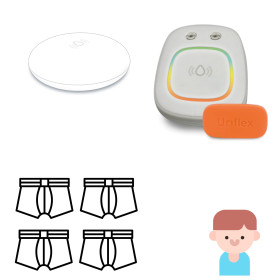
Uriflex for Boys – Set of 4 boxer shorts + Liberty wireless bedwetting alarm + vibrator
Old price: €286.85
Price: €272.50
Discount: 5%
Save up: -€14.34
Set: 1 Liberty wireless bedwetting alarm + vibrating alarm + 2 pairs of...
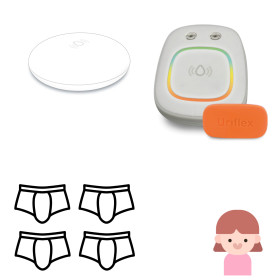
Uriflex for Girls – Set of 4 Liberty-print wireless ‘stop wee’ shorts with vibrator
Old price: €286.85
Price: €272.50
Discount: 5%
Save up: -€14.34
Set: 1 Liberty wireless night-time training alarm + vibrating alarm + 4...
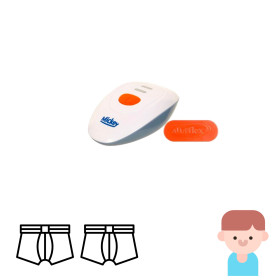
Uriflex for Boys – Set of 2 boxer shorts + Mickey Mouse wireless bedwetting alarm
Old price: €138.90
Price: €131.95
Discount: 5%
Save up: -€6.94
1 Mickey wireless alarm clock + 2 boxer shorts
5 different sounds and...
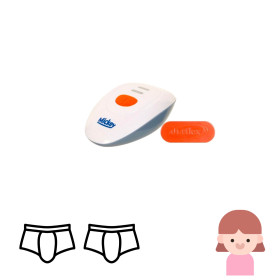
Uriflex for Girls – Set of 2 shorts + Mickey wireless wee-stop alarm
Old price: €138.90
Price: €131.95
Discount: 5%
Save up: -€6.94
1 Mickey wireless alarm clock + 2 Shortys
5 different sounds and adjustable...
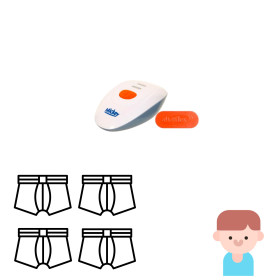
Uriflex for Boys – Set of 4 boxer shorts + Mickey Mouse wireless bedwetting alarm
Old price: €184.89
Price: €175.65
Discount: 5%
Save up: -€9.24
1 Mickey wireless alarm + 4 boxer shorts
5 different sounds and adjustable...
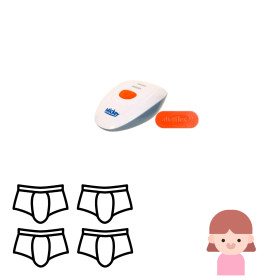
Uriflex for Girls – Pack of 4 shorts + Mickey wireless wee-stop alarm
Old price: €184.89
Price: €175.65
Discount: 5%
Save up: -€9.24
1 Mickey wireless alarm + 4 Shortys
5 different sounds and adjustable...
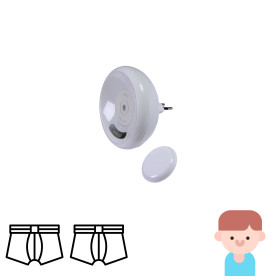
Rodger Garçon – Set of 2 boxer shorts + wireless wee-stop alarm
Old price: €143.80
Price: €136.61
Discount: 5%
Save up: -€7.19
1 Rodger wireless alarm + 2 boxers
Runs on batteries or mains power (220V)....
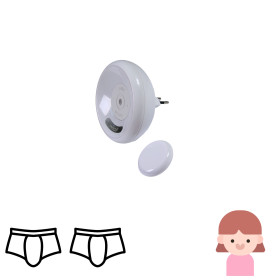
Rodger Fille – Set of 2 shorts + wireless bedwetting alarm
Old price: €143.80
Price: €136.61
Discount: 5%
Save up: -€7.19
1 Rodger wireless alarm + 2 Shortys
Operates on batteries or mains power...
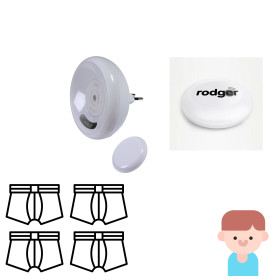
Rodger Garçon – Set of 4 boxer shorts + vibrator + wireless wee-stop alarm
Old price: €234.50
Price: €222.77
Discount: 5%
Save up: -€11.72
1 Rodger wireless alarm + 4 boxers
1 vibrating alarm
Operates on batteries...
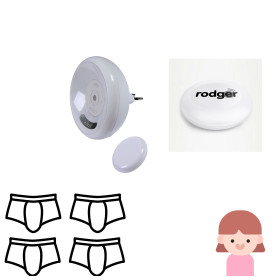
Rodger Fille – Set of 4 shorts + vibrator + wireless wee-stop alarm
Old price: €234.50
Price: €222.77
Discount: 5%
Save up: -€11.72
1 Rodger wireless alarm + 4 Shortys
1 vibrating alarm
Operates on batteries...
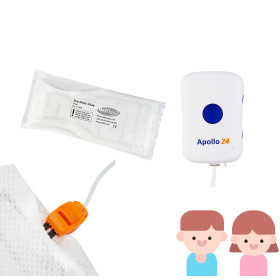
Uriflex – Pack of 25 Dry-Mate pads + Apollo 24 wee-stop alarm
Old price: €85.89
Price: €81.60
Discount: 5%
Save up: -€4.29
1 Apollo 24 + 25 Dry-Mate alarm
Multiple Alarms: Sounds, Vibrations, Sounds...
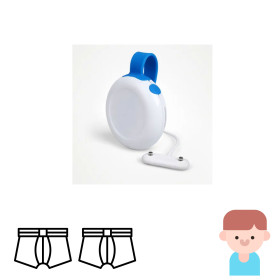
Rodger Garçon – Set of 2 boxer shorts + Amigo Button wee-stop alarm
Old price: €105.70
Price: €100.41
Discount: 5%
Save up: -€5.28
Rodger® Amigo Button Kit + 2 pairs of boxer shorts
For the treatment of...
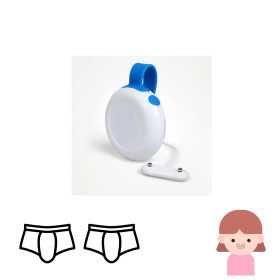
Rodger Fille – Set of 2 shorts + Amigo Button wee-stop alarm
Old price: €105.70
Price: €100.41
Discount: 5%
Save up: -€5.28
Rodger® Amigo Button Kit + 2 Shortys
For the treatment of bedwetting,...
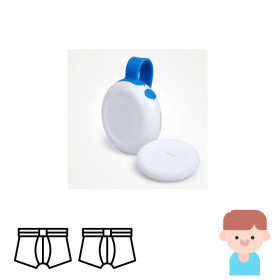
Rodger Garçon – Set of 2 boxer shorts + Amigo wireless wee-stop alarm
Old price: €115.70
Price: €109.91
Discount: 5%
Save up: -€5.78
Rodger® Amigo Wireless Kit + 2 pairs of boxer shorts
For the treatment of...
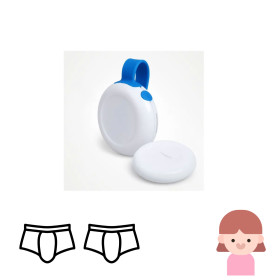
Rodger Fille – Set of 2 shorts + Amigo wireless bedwetting alarm
Old price: €115.70
Price: €109.91
Discount: 5%
Save up: -€5.78
Rodger® Amigo Wireless Kit + 2 Shorts
For the treatment of bedwetting,...





Latest comments