



Activities for learning and teaching about enuresis
If there's one thing all children in the world have in common, it's play. It's a child's first language and often their first way of understanding the world around them. "Play is a natural form of communication for children ," says Dr. Garry Landreth, founder of the Center for Play Therapy at North Texas University. " It's a comprehensive way for children to communicate their emotional, physical, mental, and social well-being. Children play to express their desires and fears."
So, how can playing help your child learn more about bedwetting?
According to the American Academy of Pediatrics (AAP), the main reasons why children wet the bed are an underdeveloped bladder that is unable to hold urine throughout the night and the child's inability to recognize when their bladder is full enough to get up and go to the bathroom. That said, bedwetting in children often stops as they grow and develop physically. The AAP reports that most children outgrow bedwetting before adolescence and that only one in 100 adults experiences this problem. According to Dr. Landreth, if parents sit with their children for 30 minutes of safe and empathetic play, they can learn a lot about how their children feel about bedwetting. Furthermore, talking with your child about bedwetting can help them feel better about themselves and improve their self-confidence.
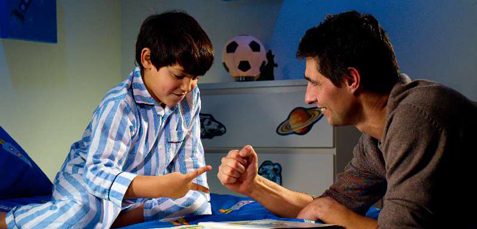
Here are some fun activities you and your child can do together to manage their bedwetting and learn more about it:
Emergency flashlight
Sometimes children are afraid to go to the bathroom at night because they are afraid of the dark. Your child can help you decorate a flashlight for them to use when they get up at night.
Materials required:- Child-safe flashlight
- Glue
- Brilliant
- Paint markers or crayons
- Ribbons
- Stickers
- If you don't already have one too many at home, going to buy a flashlight can be a fun way to start this activity.
- Make sure it is safe for children (check the packaging to see what age it is intended for).
- Next, gather all the materials.
- Decorate the flashlight with glitter, ribbons and stickers.
- You or your child can write its name on it using a paint crayon, so that it becomes their own flashlight.
- Remember not to put glue on the button to turn it on and off!
- Next, place the flashlight in a specially chosen spot next to your child's bed.
The alarm clock
Some parents find it helpful to wake their child to the bathroom in the middle of the night. If your child is old enough to wake up on their own, this alarm clock might be just what they need!
Materials required:- Child-safe flashlight
- Glue
- Brilliant
- Markers or paint pencils
- Ribbons
- Stickers
- Find a child-safe alarm clock.
- Let your child choose the color, but make sure there's room to add your personal decorations!
- Tell your child that this is their special alarm clock to help them wake up at night to go to the bathroom.
- Gather all the materials.
- Let your child give free rein to their imagination by decorating the alarm clock.
- Write the child's name in crayon, and there you have it! Now they have their own tool to wake up.
- Perhaps you should also show your child how to set the alarm, if he or she is old enough.
The Book of Enuresis
Making this book is a great way to teach your child more about bedwetting and to discover how they feel about this problem.
Materials required:- Construction paper
- Child-safe flashlight
- Glue
- Brilliant
- Paint markers or crayons
- Ribbons
- Stickers
- Pieces of fabric
- Three-hole punch or stapler for binding the book
Help your child draw a bed on the first page of the book, then let them draw and decorate the rest of the story. Ask them questions to guide them, such as:
- How does it feel to wake up in a wet bed?
- How do you think it feels to wake up in a dry bed?
- Are you tired when mom or dad wakes you up to go to the bathroom?
- Let your child draw their feelings and write an accompanying text, and let them finish the book however they want.
- Bind the book using the stapler or the three-hole punch and attach it with the ribbon.
Anatomy 101
It is educational and artistic to illustrate how the bladder works, and this can help your child better understand bedwetting. Materials required:- A simple anatomy book showing the bladder, urethra, and their functions
- Construction paper
- Markers, wax crayons, or colored pencils
- Help your child understand their bladder and the urination process by giving them a simple anatomy lesson.
- Show your child the pictures in the anatomy book and trace the path of fluids through the body.
- Teach him simple words like: bladder and kidneys.
Then help your child draw a silhouette and ask them to show you how fluids are processed in the body. This is a good opportunity to teach your child that some children's bladders mature more slowly, and that's why the "extra fluid" in their body "overflows" at night. Your child will understand why they experience bedwetting, and who knows, maybe you'll inspire a future career as a doctor or artist!
Posted in:
Practical advice





Latest comments